


We are pleased to confirm that the increased allowance officially became available on 8 April 2026.
In Cape Town, once the summer holidays had passed and the rush of getting children back to school and ourselves back to work had settled, February brought a renewed burst of activity. The city played host to the Mining Indaba, the State of the Nation Address, and the annual Budget Speech. The atmosphere surrounding these events was lighter and more optimistic than in many years, with the Budget Speech in particular, being received with a sense of positivity.
Tucked away in an annexure of the Budget was an adjustment to the Single Discretionary Allowance for South African individuals, in which the amount was increased from R1 million to R2 million. This was the first such change to the allowance in 15 years, the evolution of which is shown in the following chart:
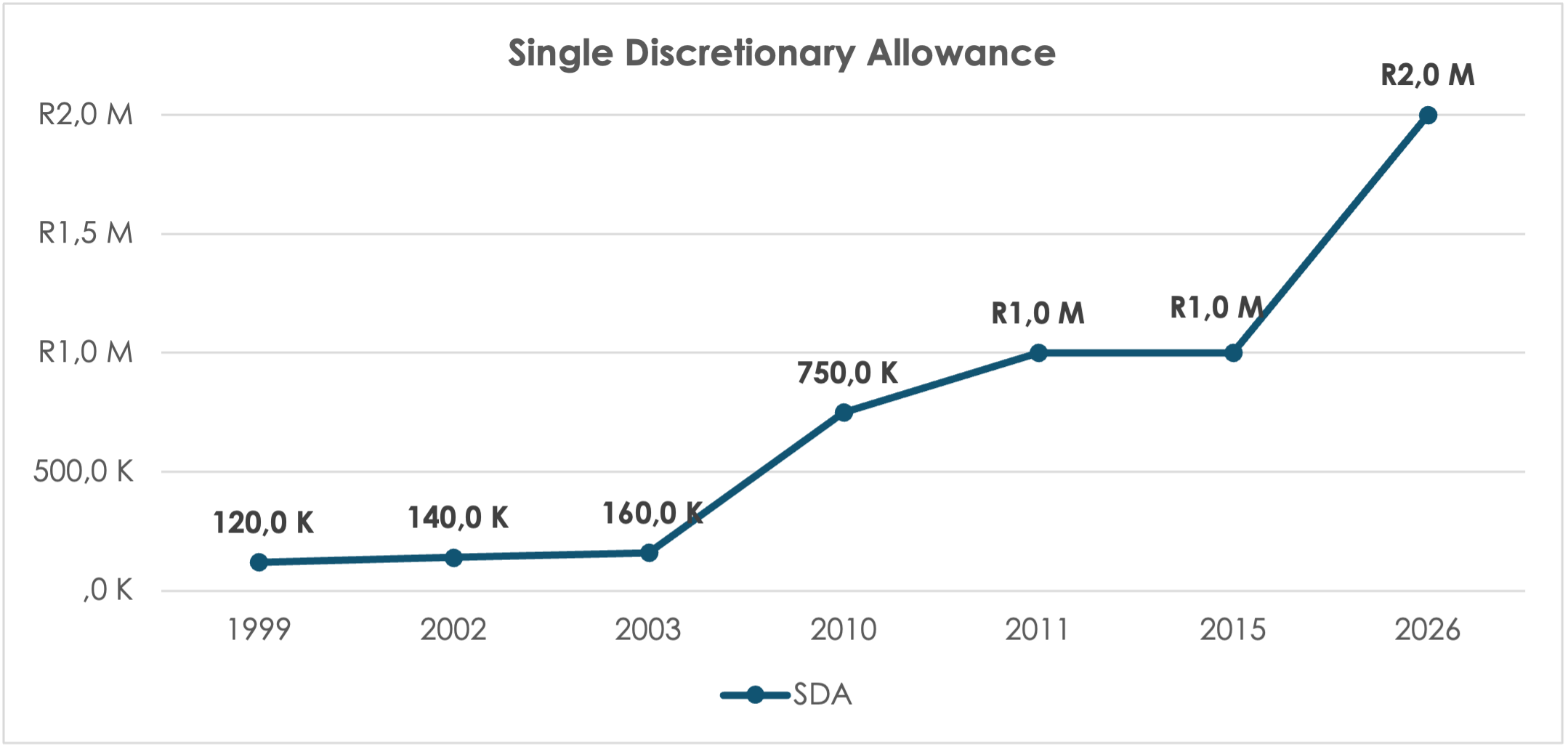
Note: The Single Discretionary Allowance in its current form was only introduced in 2008, prior to which separate allowances with different names existed.
Rationale
There were three broad points made regarding the reason for the increase, although two of those, namely 1) reducing the administrative requirements for externalising funds and 2) easing exchange controls, become somewhat irrelevant when considering the third reason: R2 million in 2026 is, in real terms, almost exactly the equivalent of R1 million in 2011. Put differently, inflation has caused the R1 million allowance to decrease (effectively halved) since 2011, and the real allowance has now simply been reset.
While not a view with which Currency Partners necessarily agrees, it is worth noting that, over the years, there have been times during which concerns were expressed that the SARB might seek to increase, rather than relax, exchange controls to protect the currency against depreciation in the face of capital flight. This announcement should allay any such fears.
Outlook
Since the announcement, we have been inundated with requests from clients wishing to externalise the additional R1 million in this calendar year. At the time the announcement was made, the ZAR/USD rate stood at 15.90, close to its best levels since June 2022. Although current global tensions have seen the rate weaken to 16.70 at the time of writing, enquiries have continued unabated regarding when these transactions could take place.
Some anticipated reactions to the change include:
- Clients fully utilising an additional 1 million: the bulk of the queries thus far have come from individual clients and wealth partners looking to transfer the full R 2 million. Numerous clients pre-funded their account in anticipation of being able to so and we therefore anticipate a flurry of activity immediately after the increase being officially confirmed.
- Increasing the percentage of clients’ offshore exposure at the margin: previously, when wealth partners’ investment proposals would result in an allocation of between R 1 or R 2 million – it’s likely that the excess exposure over R 1 million would either be achieved via local feeder funds or simply not allocated. The reason for this would be that for “smaller” amounts they would rather not go through the process to obtain an Approval for International Transfer (AIT) from SARS. These additional amounts will now likely be fully externalised.
- Switching existing feeder fund and asset swap exposure to true offshore investments: this speaks to the previous point; however, here we refer to existing exposures built up over the years that clients may now wish to have officially externalised and reported as such.
- Externalising up to and beyond R1 million while retaining the flexibility for travel spending, online purchases, and other uses with less concern of breaching SARB regulations: clients, particularly those transferring their allowances fairly early in the year, will be able to both transfer more funds while retaining a larger allocation for potential spending abroad whilst travelling, online spending in foreign currency, and other potential discretionary uses of the allowance.
Conclusion
It’s not too often that we see regulatory changes that are unambiguously positive, yet here we are. Whilst the argument is valid that this is simply the allowance “catching up” with inflation, this relaxation of exchange control limits is welcomed, and we anticipate seeing significant flows as our clients and partners seek to take advantage of the increase.
To speak to an expert, please contact us at enquiries@currencypartners.co.za or +27 21 203 0081. We look forward to hearing from you and saving you money on the exchange rates.
